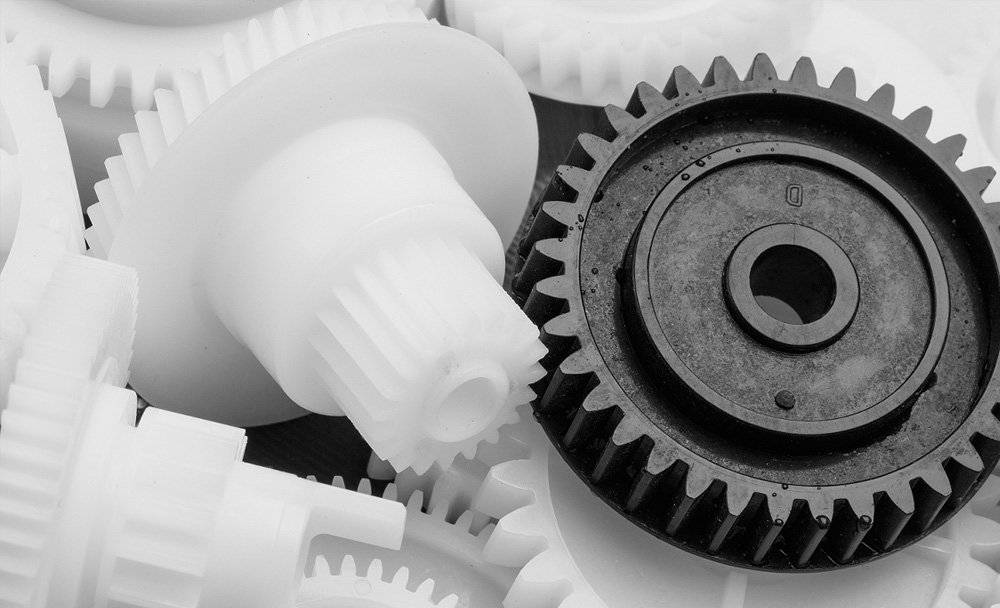
When your design calls for a component with low friction, chemical resistance, electrical insulation, or light weight — and metal is either too heavy, too conductive, or simply overkill — engineering plastics machined by CNC are the answer. Materials like Delrin, PEEK, and Nylon offer mechanical properties that rival aluminum in specific applications, at a fraction of the weight and with no corrosion risk. The challenge is sourcing them. Most CNC shops default to metal and treat plastic jobs as secondary. Shops in Tijuana with dedicated plastic machining capability provide these parts to ISO-certified quality standards — nearshore to San Diego, at 25–35% below comparable U.S. shop rates.
01 Why Machine Plastics Instead of Molding Them?
Injection molding is the standard production process for plastic parts at volume. But it requires tooling — and tooling has a cost, lead time, and minimum volume that makes it impractical for many real-world engineering situations:
| Factor | CNC Machined Plastic | Injection Molded Plastic |
|---|
| Tooling Cost | $0 — no tooling required | $5,000–$80,000+ per tool |
| Lead Time (first parts) | 5–10 business days | 4–12 weeks for tool + parts |
| Min. Order Quantity | 1 piece | Typically 500–5,000 pcs |
| Design Changes | Revise CAD, re-machine — no tool cost | Tool modification $500–$10,000+ |
| Dimensional Tolerances | ±0.002–0.005″ routinely | ±0.005–0.020″ typical |
| Material Grade Control | Specific grades, certified stock | Limited to moldable grades |
| Best Volume Range | 1–1,000 pieces | 1,000–1,000,000+ pieces |
💡
The Bridge Strategy
Many product teams use CNC machined plastic parts as bridge production while injection mold tooling is being cut. This keeps production flowing, validates the design under real operating conditions, and allows final geometry adjustments before committing the mold — often saving one or two expensive tool modifications.
02 Engineering Plastics Available: Delrin, PEEK, Nylon & More
Not all plastics machine equally. Each engineering plastic has a distinct capability profile that makes it the right — or wrong — choice for a given application:
POM
Delrin (Acetal) — POM-C
The most machinable engineering plastic. Excellent dimensional stability, low friction, and stiffness. Default choice for gears, bushings, wear pads, and precision structural components.
PEEK
Polyether Ether Ketone
Highest-performance engineering plastic. Retains mechanical properties up to 250°C, chemically resistant to almost everything, biocompatible. Used in aerospace, medical devices, and chemical processing.
PA
Nylon (PA6 / PA66)
Excellent toughness, fatigue resistance, and vibration damping. Self-lubricating in sliding applications. Common for gears, rollers, cable guides, and structural brackets. Hygroscopic — absorbs moisture.
UHMW
Ultra-High Molecular Weight PE
Extraordinary impact and abrasion resistance at very low cost. Used for wear liners, conveyor guides, cutting boards, and marine components. Difficult to machine precisely due to softness.
PC
Polycarbonate
Outstanding optical clarity and impact resistance. Used for sight glasses, light covers, transparent enclosures, and safety shields. Scratches easily — consider coating for cosmetic applications.
PTFE
Teflon (PTFE)
Lowest coefficient of friction of any solid. Chemically inert, wide temperature range (−200°C to +260°C). Used for seals, gaskets, valve seats, and chemical-contact components. Very soft — difficult to hold tight tolerances.
03 Material Comparison — Choosing the Right Plastic
Use this reference to narrow material selection before sending your RFQ. When in doubt, our engineering team will recommend the right grade during DFM review:
| Material | Max Temp. | Chemical Resistance | Machinability | Cost | Best For |
|---|
| Delrin (POM-C) | 90°C | Good | Excellent | Low | Gears, bushings, precision parts |
| PEEK | 250°C | Excellent | Good | High | Aerospace, medical, chemical |
| Nylon PA6 | 100°C | Good | Good | Low–Mid | Gears, rollers, structural |
| Nylon PA66 | 120°C | Good | Good | Low–Mid | Higher-temp nylon applications |
| UHMW-PE | 80°C | Excellent | Moderate | Very Low | Wear liners, guides, food contact |
| Polycarbonate | 115°C | Moderate | Good | Low–Mid | Transparent parts, sight glasses |
| PTFE | 260°C | Excellent | Moderate (creeps) | Mid–High | Seals, chemical contact, low friction |
| PEEK (GF30) | 260°C | Excellent | Moderate | Very High | Structural PEEK, higher stiffness |
⚠️
Nylon & Moisture Absorption
Nylon (PA6, PA66) is hygroscopic — it absorbs moisture from the air, causing dimensional changes and affecting mechanical properties. For tight-tolerance Nylon parts, specify that stock be dried before machining and that final dimensions be measured in a controlled-humidity environment. Parts in service will reach equilibrium moisture content over time; account for this in your design clearances.
04 Tolerances, Surface Finish & Quality Documents
Achievable Tolerances by Material
Engineering plastics are less dimensionally stable than metals — they respond to temperature, humidity, and cutting forces differently. Realistic tolerance expectations by material:
Delrin (POM-C)±0.002–0.003″
PEEK±0.002–0.003″
Nylon PA6 / PA66±0.003–0.005″
Polycarbonate±0.003–0.005″
UHMW-PE±0.005–0.010″
PTFE±0.005–0.010″
General tolerance (all materials)±0.005″
⚠️
Thermal Expansion in Plastics
Engineering plastics have 5–10× higher thermal expansion coefficients than metals. A Delrin part machined at 20°C will be measurably different at 40°C operating temperature. For parts that must mate with metal components across a temperature range, account for differential thermal expansion in your clearance calculations — especially for press-fit or close-clearance applications.
Surface Finish Options
| Finish | Ra Value | Best For | Availability |
|---|
| As-Machined | Ra 1.6–3.2 µm | Functional parts, structural components | ✓ Standard |
| Fine Machined | Ra 0.8 µm | Sealing surfaces, optical-adjacent parts | ✓ Standard |
| Polished (PC/PEEK) | Ra <0.4 µm | Optical clarity, cosmetic transparency | ◑ On request |
| Bead Blast | Ra 1.5–3 µm | Matte finish, hide tool marks | ✓ Standard |
| Painting / Coating | — | Color coding, UV protection | ◑ On request |
Quality Documentation Available
| Document | Description | Available |
|---|
| Certificate of Conformance (CoC) | Signed cert that parts meet drawing specifications | ✓ Standard |
| Material Test Report (MTR) | Material cert with grade, lot, and compliance (FDA, RoHS) | ✓ Included |
| First Article Inspection (FAI) | Full dimensional buy-off on first piece | ✓ Every new part |
| FDA Compliance Documentation | Material compliance for food-contact or medical-adjacent applications | ✓ Where applicable |
| RoHS / REACH Compliance | Substance compliance for electronics and EU market products | ✓ On request |
| CMM Inspection Report | Dimensional verification for critical features | ✓ In-house |
05 Common Applications for CNC Machined Plastic Parts
Gears, Cams & Drive Components
Delrin and Nylon are the go-to materials for plastic gears and drive components in light-to-medium duty applications. They run quietly against metal gears, require no lubrication, and absorb shock loads that would chip a metal tooth. Common in packaging equipment, medical devices, robotics, and automation systems.
Bushings, Wear Pads & Sliding Components
UHMW-PE and Delrin are widely used for plain bearings, wear liners, slider pads, and guide rails in conveyor systems and material handling equipment. Their low coefficient of friction and abrasion resistance extend service life dramatically compared to metal-on-metal contact.
Medical Device Components
PEEK is the material of choice for non-implantable medical device structural components — MRI-compatible, biocompatible in standard grades, sterilizable by autoclave, EtO, and gamma radiation. Machined PEEK housings, brackets, and instrument bodies are produced routinely in Tijuana’s medical device manufacturing ecosystem.
Chemical Processing Components
PTFE and PEEK valve seats, seal carriers, manifold blocks, and fluid contact components for aggressive chemical environments. These materials handle acids, solvents, and oxidizers that would destroy metal parts — and they machine cleanly into complex geometries that would be impossible to achieve with formed or molded PTFE.
Electrical Insulation Components
Polycarbonate, Delrin, and PEEK provide excellent electrical insulation for standoffs, spacers, terminal blocks, and bus bar separators in high-voltage assemblies. Machined from rod or sheet stock to tight dimensional tolerances not achievable in molded parts.
Aerospace & Defense Brackets
PEEK and glass-filled Nylon for lightweight structural brackets, cable management clips, and interior structural components where metal replacement with engineered plastic saves significant weight without sacrificing mechanical performance required by the application.
06 How the Sourcing Process Works with Baja Supplies
Baja Supplies manages the full cycle — material procurement, machining, inspection, and delivery — so you get nearshore quality without managing a foreign supplier directly.
1
Submit Your RFQ
Send your STEP file or 2D drawing, material specification (grade matters — specify «Delrin POM-C» not just «plastic»), tolerance callouts, quantity, and any compliance requirements (FDA, RoHS, biocompatibility). We send you the NDA.
2
Material & DFM Review
Our team reviews material suitability for your application, flags any geometry that will cause fixturing or tolerance challenges specific to the plastic specified, and confirms stock availability. Quotes returned in 24–72 hours.
3
Supplier Match & PO
We route your job to the shop in our network with the right plastic machining capability and tooling for your material. One PO to Baja Supplies — one point of contact, one invoice, one documentation package.
4
Production & Inspection
First articles are dimensionally verified before the production run releases. Material certifications are collected at point of stock purchase and included in the documentation package. Critical features confirmed via CMM.
5
Delivery to Your Dock
Parts cross at Otay Mesa daily with full USMCA documentation. San Diego-area delivery same day they ship. Anywhere in the continental U.S. within 2–3 days by ground freight.
07 Design Tips That Reduce Cost on Machined Plastic Parts
Plastic parts have specific DFM considerations that differ from metal. These tips apply across all engineering plastic grades:
✓
Specify the Grade, Not Just the Family
«Nylon» is not a specification — PA6, PA66, PA6-GF30, PA12, and nylon cast rod all have different properties and costs. Specify the exact grade your design requires, or describe the functional requirements (temperature, chemical exposure, load) and let our team confirm the right grade. Wrong material selection is the most common cause of plastic part failure in service.
✓
Keep Wall Thickness Uniform
Uneven wall thickness causes residual stress and warping — especially in Nylon and Polycarbonate. Aim for uniform wall thickness throughout the part and avoid abrupt transitions between thick and thin sections. If thin walls are unavoidable, machine them last after bulk material removal.
✓
Avoid Sharp Internal Corners
Sharp internal corners in plastic parts concentrate stress and create crack initiation points under cyclic loading. Add a minimum 0.5mm radius at all internal corners — both for stress distribution and because it’s cheaper to machine than a true sharp corner. For PEEK or Nylon under repeated load, increase to 1mm or more.
✓
Use Metal Inserts for Threaded Holes
Direct threads in plastic — especially Nylon and PTFE — wear rapidly under repeated assembly cycles. Use heat-set or press-in brass inserts for any threaded hole that will be assembled more than 5–10 times. This is inexpensive to add during machining and dramatically extends service life. Specify the insert type — M2 through M8 inserts are stocked locally in Tijuana.
✓
Design Clearance for Thermal Expansion
If your plastic part mates with a metal component across a significant temperature range, account for differential expansion. Add 0.001–0.002″ per inch of dimension per 10°C of temperature range on top of your normal functional clearance. This prevents binding at high temperature without excessive slop at ambient.
08 Frequently Asked Questions
What engineering plastics can be CNC machined in Tijuana?
Our network regularly machines Delrin (POM-C), PEEK (standard and GF30), Nylon PA6 and PA66, UHMW-PE, Polycarbonate, PTFE, and Acetal. Most standard engineering plastic grades are stocked locally or available within 24–48 hours. Specialty grades (PEEK CF30, Torlon, Ultem) are available on request with slightly longer material lead times.
What tolerances can CNC shops in Tijuana achieve on plastic parts?
Standard general tolerance is ±0.005″. Delrin and PEEK can achieve ±0.002–0.003″ with proper fixturing and controlled machining conditions. Nylon requires moisture conditioning before final machining for tight-tolerance work. UHMW and PTFE are soft and prone to deflection — realistic tolerances are ±0.005–0.010″ for these materials.
Can PEEK parts be sourced for medical device applications?
Yes. PEEK in its standard grade is FDA-compliant and biocompatible, making it suitable for non-implantable medical device components. Shops in our network provide Material Test Reports with FDA compliance data, Certificates of Conformance, and full lot traceability. For implantable-grade PEEK, contact us to discuss specialized material sourcing and documentation requirements.
When should I use machined plastic parts vs. injection molded?
CNC machined plastics are the right choice when quantities are under 500–1,000 pieces, when design iteration is ongoing, when tight tolerances or specific engineering grades are required, or when you need parts quickly without tooling lead time. Injection molding becomes more economical above 1,000–5,000 pieces depending on part complexity and material.
How long does it take to get CNC machined plastic parts from Tijuana?
Simple parts in stocked materials typically complete in 5–8 business days from approved drawing. Complex multi-setup parts or those requiring specialty material procurement may take 10–15 days. Parts cross the Otay Mesa border daily and arrive at San Diego-area facilities same day they ship.
Is there a minimum order quantity?
No minimum order quantity. Single-piece prototype orders are accepted at the same quality standard as production runs. PEEK and other high-cost materials may carry a minimum material charge for very small quantities — this is noted in the quote.
Can you provide FDA or RoHS compliance documentation for plastic materials?
Yes. Material Test Reports for engineering plastics include FDA compliance status, RoHS/REACH compliance, and lot traceability as standard. For medical device applications requiring specific biocompatibility documentation (ISO 10993), contact us to confirm the appropriate material grade and documentation package before placing your order.
Get a Quote in 24–72 Hours
Send us your STEP file or drawing with material specification. Our engineering team will review material suitability, DFM, and come back with pricing and lead time — no commitment required.
- Delrin, PEEK, Nylon, UHMW, PC, PTFE & more
- Single piece to production runs — no minimum order
- FDA & RoHS compliance documentation available
- Delivery to San Diego in as little as 5 business days
Request a Quote →