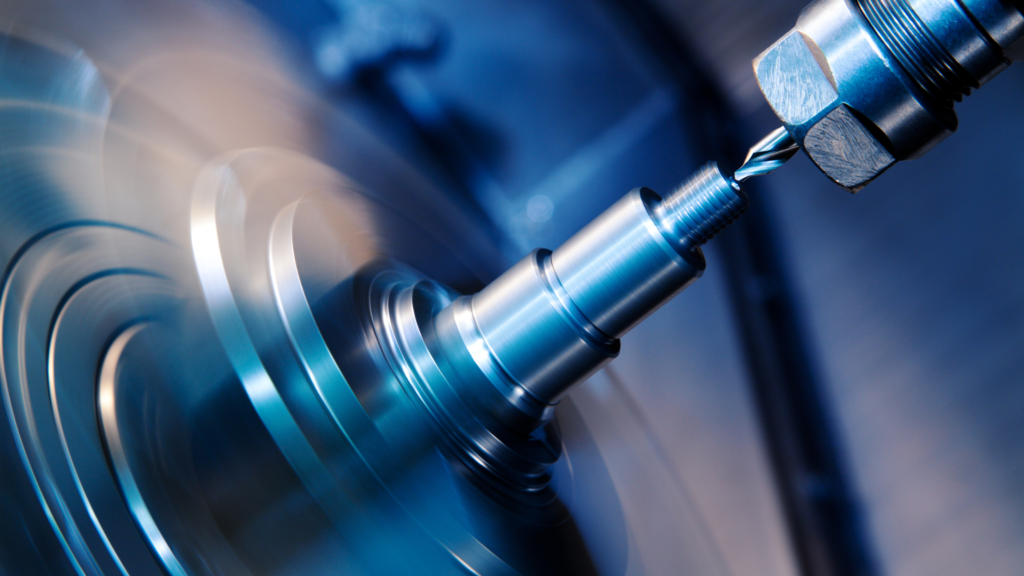
When your design calls for a shaft, bushing, fitting, pin, or any part defined primarily by a circular cross-section, CNC turning is the process. It’s fast, repeatable, and capable of extremely tight diameter tolerances — the backbone of any precision mechanical assembly. The challenge for most U.S. OEM buyers is the same across all machining: domestic shops charge a premium and carry long backlogs, while Asian suppliers mean weeks of ocean freight, quality uncertainty, and IP exposure. CNC turning shops in Tijuana offer a proven alternative — same time zone as San Diego, ISO-certified quality, and costs 25–40% below U.S. rates.
01 Why CNC Turning Is the Right Process for Rotational Parts
CNC turning rotates the workpiece against a stationary cutting tool to produce cylindrical features with exceptional concentricity and surface finish. It’s the preferred process whenever your part has one or more of these characteristics:
Geometry
Cylindrical Form
Shafts, pins, rods, sleeves — any part defined by a circular cross-section is a natural fit for turning.
Precision
Tight Diameter Tols.
Turning achieves ±0.0005″ diameter tolerances routinely — critical for bearing seats, press fits, and sliding fits.
Speed
Fast Cycle Time
Turning removes material rapidly. Simple turned parts can cycle in seconds to minutes, making it highly cost-efficient at volume.
Finish
Surface Quality
Turned surfaces achieve Ra 0.8 µm or better as-machined — often eliminating secondary grinding for non-critical features.
💡
Turning vs. Milling
If your part is predominantly cylindrical — even with a few flat or drilled features — turning is almost always faster and cheaper than milling. The rule of thumb: if the part can be held in a chuck, it should be turned. Reserve milling for prismatic parts where no rotational axis dominates the geometry. Modern live-tool lathes add keyways, cross-holes, and flats in the same setup.
02 Materials Available: Steel, Aluminum & Beyond
CNC turning shops in Tijuana carry stock in all standard engineering materials. Here are the most commonly turned materials and what they’re best for:
Aluminum Alloys
6061-T6
General Purpose
Most commonly turned aluminum. Excellent machinability, great for spacers, bushings, light shafts, and structural fittings. Stocked same-day locally.
7075-T6
High Strength
For high-load shafts and fasteners where strength-to-weight is critical. Harder on tooling but well within shop capability.
2024
Fatigue Resistant
Used in aerospace axles and structural pins where fatigue life under cyclic loading is the primary design driver.
Steel Alloys
1018
Mild Steel — Easy to Machine
Low-cost, high-machinability for shafts, pins, and non-critical structural components. Welds and machines cleanly.
4140
Alloy Steel — Workhorse
The most common choice for loaded shafts, drive components, and tooling. Good combination of strength, toughness, and machinability.
4340
High-Strength Alloy
For demanding applications requiring higher tensile strength than 4140 — aerospace actuators, heavy equipment shafts, landing gear components.
Stainless Steel & Other Materials
304 SS
General Use Stainless
Corrosion-resistant for food equipment, medical instruments, and marine hardware. Good machinability for a stainless grade.
316 SS
Marine / Chemical Grade
Superior chloride resistance. Standard for fittings, valves, and fasteners in harsh environments.
C360 Brass
Free-Machining Brass
The easiest metal to machine. Ideal for fittings, valves, electrical connectors, and decorative hardware with tight tolerances.
💡
Material Selection Tip
4140 pre-hardened covers 80% of steel shaft applications. It arrives at the shop already heat-treated to ~28–32 HRC, machines well, and provides enough strength for most drive, structural, and tooling applications. Only upgrade to 4340 if your FEA shows 4140 falling short of required safety factors.
03 Tolerances, Surface Finish & Quality Documents
Achievable Tolerances
CNC turning is inherently more precise than milling for diameter dimensions. Here’s a realistic breakdown from shops in Tijuana running Haas ST, Okuma, Hardinge, and Colchester equipment:
General Diameter
±.005″
±0.127 mm
Standard
±.001″
±0.025 mm
Precision Fits
±.0005″
±0.013 mm
Length / Shoulder
±.002″
±0.051 mm
Runout (TIR)
0.001″
Typical
CMM Verification
In-house
All critical features
⚠️
Fit Classes & Tolerance Callouts
When specifying turned parts for bearing seats, press fits, or sliding fits, always use ISO fit system callouts (e.g., H7/h6, H7/p6) rather than symmetric ±tolerances. This gives the shop clear functional intent and avoids over-tolerancing the shaft while under-tolerancing the bore — a common source of assembly problems.
Surface Finish Options
| Finish | Ra Value | Best For | Availability |
|---|
| As-Turned | Ra 1.6–3.2 µm | General OD features, non-sealing surfaces | ✓ Standard |
| Fine Turned | Ra 0.8 µm | Bearing seats, sealing ODs, precision fits | ✓ Standard |
| Ground (OD) | Ra 0.2–0.4 µm | High-precision shafts, hardened surfaces | ◑ Via allied shop |
| Anodize (aluminum) | — | Corrosion protection, wear resistance | ◑ Allied finisher |
| Black Oxide (steel) | — | Mild corrosion resistance, cosmetic finish | ◑ Allied finisher |
| Zinc Plate (steel) | — | Corrosion protection for fasteners and hardware | ◑ Allied finisher |
| Passivation (stainless) | — | Restore native oxide layer after machining | ◑ Allied finisher |
Quality Documentation Available
| Document | Description | Available |
|---|
| Certificate of Conformance (CoC) | Signed cert that parts meet drawing specifications | ✓ Standard |
| Material Test Report (MTR) | Mill cert tracing material heat/lot to spec | ✓ Included |
| First Article Inspection (FAI) | Full dimensional buy-off on first piece | ✓ Every new part |
| Cpk / SPC Reports | Statistical process capability for critical diameters | ✓ On request |
| PPAP (Level 1–3) | Production Part Approval Process for automotive | ✓ Supported |
| CMM / Air Gauge Report | Precision diameter verification for critical fits | ✓ In-house |
04 The Nearshore Advantage: Tijuana vs. Domestic vs. Asia
The same comparison that applies to milled parts holds — and in some ways is even more compelling — for turned parts, where cycle times are shorter and volume economics kick in faster:
| Factor | U.S. Domestic | Tijuana Nearshore | Asia (China/Taiwan) |
|---|
| Unit Cost | Highest | 25–40% below U.S. | Lowest (volume) |
| Lead Time | 2–6 weeks | 5–15 business days | 4–10 weeks + shipping |
| Time Zone | Same | Same (Pacific) | 12–15 hr difference |
| Min. Order Qty | 1 pc | 1 pc | Often 100–1,000 pc |
| IP / NDA Protection | Strong | Strong (USMCA) | Moderate risk |
| Site Visit / Audit | Easy | 30–60 min from SD | Flight required |
| Border Logistics | None | Daily runs, Otay Mesa | Customs + freight risk |
«Turned parts are where the nearshore cost argument is strongest — cycle times are short, so labor rate differences translate directly into part price. You feel the savings immediately.»
— Baja Supplies Sourcing Team
05 Common Applications for CNC Turned Parts
Shafts & Axles
Drive shafts, motor shafts, lead screws, and pivot axles in 4140, 4340, or stainless steel. These are typically the highest-volume, most repeatable turned parts in a production program — and the ones where nearshore cost savings compound most quickly at scale.
Bushings & Sleeves
Plain bearings, wear sleeves, and liner inserts in bronze, brass, aluminum, or stainless. Turned to precise ID/OD tolerances for press-fit or slip-fit assembly. Commonly used in robotics, automation, medical devices, and agricultural equipment.
Threaded Fittings & Adapters
Hydraulic fittings, pneumatic adapters, fluid connectors, and threaded inserts in 303/304 stainless, brass, or aluminum. Thread forms include NPT, NPTF, BSP, UN, and metric — all cut on-machine without secondary operations.
Spacers & Standoffs
Precision spacers, shoulder bolts, and standoffs in aluminum, steel, or stainless. Simple geometry but tight length tolerances — ideal for batch production in Tijuana where cycle times are measured in seconds.
Flanges & Hubs
Mounting flanges, shaft hubs, coupling halves, and sprocket blanks. Often combine turning for OD/bore features with milling for bolt patterns, keyways, and set-screw flats — accomplished in a single setup on live-tool lathes.
Pins & Dowels
Hardened and ground pins, taper pins, and precision dowels for tooling, fixtures, and assembly alignment. Turned to h6 or tighter tolerances for reliable interference and slip-fit assembly. Hardening and OD grinding available through allied processors.
06 How the Sourcing Process Works with Baja Supplies
Baja Supplies manages the full sourcing cycle — from RFQ to delivery — so you get the quality and speed of a nearshore shop without managing a foreign supplier directly.
1
Submit Your RFQ
Share your 2D drawing (PDF) or 3D file (STEP/IGES), material spec, tolerance callouts, quantity, and target delivery. We accept any CAD format and send you the NDA — not the other way around.
2
DFM Review & Quoting
Our engineering team reviews for manufacturability — flagging undercuts, thread depths, or tolerance callouts that will spike cost unnecessarily. Quotes returned in 24–72 hours for standard turned parts.
3
Supplier Match & PO
We route your job to the right shop based on chuck capacity, material, tolerance requirements, and current queue. One PO to Baja Supplies — one point of contact, one invoice.
4
Production & In-Process Inspection
First articles are verified against your FAI checklist using in-house CMM and precision air gauging. Critical diameters are confirmed before the production run releases.
5
Documentation Package
Before shipment you receive: CoC, MTRs, and CMM/air-gauge inspection data — in English, formatted to your supplier quality requirements. PPAP available on request.
6
Border Crossing & Delivery
Parts cross daily at Otay Mesa with full USMCA documentation. San Diego-area delivery same day they ship — anywhere in the continental U.S. within 2–3 days by ground freight.
07 Design Tips That Reduce Cost on CNC Turned Parts
Turned parts are relatively forgiving to design — but a few choices have an outsized impact on price per piece:
✓
Minimize Diameter Steps
Every shoulder on a stepped shaft requires a tool pass and a potential re-fixturing. Reduce the number of distinct diameters to the minimum your design allows. Combining two similar diameters into one often saves a tool change and a setup verification without affecting function.
✓
Add Relief Grooves at Shoulders
Sharp inside corners at diameter transitions are difficult to hit with standard tooling. Add a 0.5–1mm undercut relief groove at each shoulder — it’s faster to machine, produces a cleaner corner, and makes grinding easier if the part is hardened after turning.
✓
Reserve Tight Tolerances for Mating Features Only
Only the OD that seats a bearing, the bore that takes a shaft, or the thread that must seal needs a precision callout. Everything else should be ±0.005″ general tolerance. Over-tolerancing non-functional surfaces is the most common reason turned parts cost 2–3× more than they need to.
✓
Keep Length-to-Diameter Ratio Under 4:1
Long, slender parts (L/D > 4:1) deflect during turning, making tight diameter tolerances difficult along the full length. If your shaft is long and slender, discuss steady rest or tailstock support with the shop — or consider whether a hollow tube section could reduce L/D while maintaining stiffness.
✓
Use Standard Bar Stock Diameters
Starting from standard bar stock sizes (0.5″, 0.75″, 1.0″, 1.25″, 1.5″, 2.0″ imperial — 12, 16, 20, 25, 30mm metric) eliminates saw-cut setup and ensures same-day material availability in Tijuana. Non-standard starting diameters add 1–2 days of procurement lead time and material waste cost.
08 Frequently Asked Questions
What materials can be CNC turned in Tijuana?
Our network regularly turns 6061 and 7075 aluminum, 1018, 4140, and 4340 steel, 304 and 316 stainless steel, brass (C360), copper, and bronze. Titanium and Inconel are available on request with slightly longer material lead times. All stock is sourced from qualified distributors with full MTR traceability.
What tolerances can CNC turning shops in Tijuana achieve?
Standard diameter tolerance is ±0.001″. For bearing seats and precision fits, ±0.0005″ is routinely achieved using in-house CMM and air-gauge verification. Shoulder length tolerances are typically ±0.002″. Runout (TIR) of 0.001″ is achievable on standard turned parts.
What types of CNC turned parts can you source?
Common parts include shafts, pins, dowels, bushings, sleeves, spacers, standoffs, flanges, hubs, threaded fittings, adapters, and custom rotational components in virtually any material. Live-tool lathes allow keyways, cross-drilled holes, and flats to be added in the same setup without secondary operations.
How fast can I get CNC turned parts from Tijuana?
Prototypes and small batches (1–50 pcs) typically complete in 5–10 business days from approved drawing. Medium production runs (100–500 pcs) run 2–4 weeks. Parts cross the Otay Mesa border daily and arrive at San Diego-area facilities same day they ship.
Are the shops ISO 9001 certified? What quality docs do they provide?
Yes. Core suppliers in our network are ISO 9001 certified and provide CoC, MTR, FAI reports, CMM and air-gauge dimensional printouts, and Cpk data on request. PPAP packages (Levels 1–3) are supported for automotive-adjacent programs.
Is there a minimum order quantity?
No minimum order quantity. Shops in our network run single-piece prototypes on the same lathes as production blankets of 10,000+ parts. High-Mix / Low-Volume (HMLV) is a core competency of the Tijuana manufacturing ecosystem.
Can you handle heat treatment and surface finishing?
Yes. Through our network of allied suppliers we coordinate heat treatment (through-hardening, case hardening, nitriding), OD grinding, anodizing, zinc plating, black oxide, and passivation. Parts arrive at your dock fully finished and documented — no secondary supplier management required on your end.
Get a Quote in 24–72 Hours
Send us your 2D drawing or STEP file and our engineering team will come back with pricing, lead time, and DFM feedback — no commitment required.
- Any CAD format accepted (STEP, IGES, DXF, PDF drawing)
- Prototype to production — no minimum order quantity
- ISO 9001 certified suppliers, CMM inspection included
- Delivery to San Diego in as little as 5 business days
Request a Quote →